
|
Size: 2476
Comment:
|
Size: 2233
Comment:
|
| Deletions are marked like this. | Additions are marked like this. |
| Line 1: | Line 1: |
| = Power On = | = Remotely power on a notebook / desktop of IMATH = <<TableOfContents>> |
| Line 3: | Line 4: |
| The idea of this new feature is simple, everyone should be able to wake their machine using localinfo. We use the standard Wake on Lan (in short WOL) feature to accomplish this. | |
| Line 5: | Line 5: |
| If you'd like to use this feature with your computer or notebook, please check the list under localinfo > power on if your devices are listed correctly. | |
| Line 7: | Line 6: |
| Next thing is to check your machine, it should be connected via an ethernet port with a yellow point on it, wireless lan won't work. | The idea of this feature is simple, everyone should be able to wake their machine using localinfo. We use the standard 'Wake on Lan' (in short WOL) feature to accomplish this. |
| Line 9: | Line 8: |
| If both things are okay, the client has to be configured. | The following steps have to be taken: 1. Activate WOL on the Device 1. Log in to localinfo: http://www.math.uzh.ch > LI > Remote Power On (WOL) * Check if the device is on the list 1. WOL only works over the yellow tagged network (LAN). WOL over WIFI is not supported. |
| Line 11: | Line 14: |
| == Mac OS X == | = Activate WOL = |
| Line 13: | Line 16: |
| Open system preferences -> Energy saving options -> wake for network access (or wake for wifi on most notebooks). Done. Sadly this quick and easy setup also has one negative point - you have to leave the machine in sleep mode to boot it over LAN. |
== BIOS: Linux / Windows == |
| Line 16: | Line 18: |
| == Windows == | Enter the BIOS Setup at startup of the machine. Look for the an Option like `Power on by PCIE Devices`, `Power On by onboard Lan`, `On Board LAN boot (rom)` (!) and set it to enable. It is usually under `Boot` or `Advanced`. |
| Line 18: | Line 20: |
| Most computers support Wake on LAN on a wired network. The Wake on LAN feature allows you to turn on a computer in SLEEP or HIBERNATE mode via the network. The HIBERNATE mode usually is present when you shut down your machine and leave it connected to an active powerline. As soon as it doesn't have an external power source anymore, it quits HIBERNATE mode and shuts down completely to save battery. To enable Wake on LAN (WOL): 1. On bootup, instructions to access the BIOS will be briefly displayed. Press this button to enter the BIOS. The hot key is commonly either DEL, F12, or F8. 2. Using your BIOS, modify the boot sequence to make LAN first priority. 3. In a generic BIOS, boot priority settings can be found in the Boot Menu. 4. In the BIOS Setup program, set the items Power On by PCIE devices and Power On by Onboard Lan to [Enabled]. |
== OS: Mac OS X == * Open system preferences -> Energy saving options -> wake for network access (or wake for wifi on most notebooks). * General: if you leave your office, use '''sleep''' instead of '''Power Off'''. Note: Some Mac Mini (10.9) don't support WOL. == OS: Windows == |
| Line 28: | Line 30: |
| 1. Right-click Computer, then click Properties > Device Manager. | 1. Right-click Computer > Properties > Device Manager. |
| Line 31: | Line 33: |
| {{attachment:wol_windows.png}} 4. Use Windowskey + R and type: `shell:::{67718415-c450-4f3c-bf8a-b487642dc39b}` {{attachment:windows1.png}} 5. |
|
| Line 32: | Line 38: |
| == Linux == | == OS: Linux == |
| Line 34: | Line 40: |
| As with windows above, you need to set it in the bios first. | * Install ethtools `sudo apt-get install ethtool` * Run the command (necessary after each boot) {{{ sudo /sbin/ethtool -s eth0 wol g }}} * Auto activation during boot: |
| Line 36: | Line 45: |
| To enable Wake on LAN (WOL): 1. On bootup, instructions to access the BIOS will be briefly displayed. Press this button to enter the BIOS. The hot key is commonly either DEL, F12, or F8. 2. Using your BIOS, modify the boot sequence to make LAN first priority. 3. In a generic BIOS, boot priority settings can be found in the Boot Menu. 4. In the BIOS Setup program, set the items Power On by PCIE devices and Power On by Onboard Lan to [Enabled]. |
* For Debian / Ubuntu Linux (without network manager) edit /etc/network/interfaces and append the following to eth0: {{{ auto eth0 iface eth0 inet static address 192.168.1.1 netmask 255.255.255.0 gateway 192.168.1.254 post-up /sbin/ethtool -s eth0 wol g post-down /sbin/ethtool -s eth0 wol g }}} |
| Line 42: | Line 55: |
| Enabling WOL under Linux: | * For RHEL / SL / Fedora / CentOS Linux, edit /etc/sysconfig/network-scripts/ifcfg-eth0 and add / modify the following line: {{{ ETHTOOL_OPTS="wol g" }}} * or {{{ ETHTOOL_OPTS="wol g autoneg off speed 100 duplex full " }}} |
Remotely power on a notebook / desktop of IMATH
Contents
The idea of this feature is simple, everyone should be able to wake their machine using localinfo. We use the standard 'Wake on Lan' (in short WOL) feature to accomplish this.
The following steps have to be taken:
- Activate WOL on the Device
Log in to localinfo: http://www.math.uzh.ch > LI > Remote Power On (WOL)
- Check if the device is on the list
- WOL only works over the yellow tagged network (LAN). WOL over WIFI is not supported.
Activate WOL
BIOS: Linux / Windows
Enter the BIOS Setup at startup of the machine. Look for the an Option like Power on by PCIE Devices, Power On by onboard Lan, On Board LAN boot (rom)  and set it to enable. It is usually under Boot or Advanced.
OS: Mac OS X
Open system preferences -> Energy saving options -> wake for network access (or wake for wifi on most notebooks).
General: if you leave your office, use sleep instead of Power Off.
Note: Some Mac Mini (10.9) don't support WOL.
OS: Windows
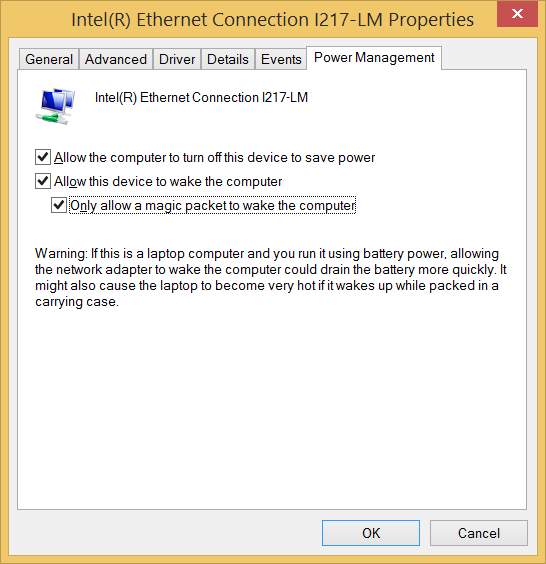
To enable WOL under Windows:
Right-click Computer > Properties > Device Manager.
- Under Network Adapters, double-click the device.
- Tick all the items under the Power Management tab.
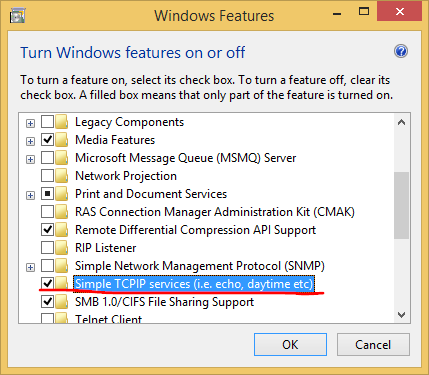
Use Windowskey + R and type: shell:::{67718415-c450-4f3c-bf8a-b487642dc39b}
OS: Linux
Install ethtools sudo apt-get install ethtool
Run the command (necessary after each boot)
sudo /sbin/ethtool -s eth0 wol g
- Auto activation during boot:
For Debian / Ubuntu Linux (without network manager) edit /etc/network/interfaces and append the following to eth0:
auto eth0
iface eth0 inet static
address 192.168.1.1
netmask 255.255.255.0
gateway 192.168.1.254
        post-up /sbin/ethtool -s eth0 wol g
        post-down /sbin/ethtool -s eth0 wol g
For RHEL / SL / Fedora / CentOS Linux, edit /etc/sysconfig/network-scripts/ifcfg-eth0 and add / modify the following line:
ETHTOOL_OPTS="wol g"
or
ETHTOOL_OPTS="wol g autoneg off speed 100 duplex full "